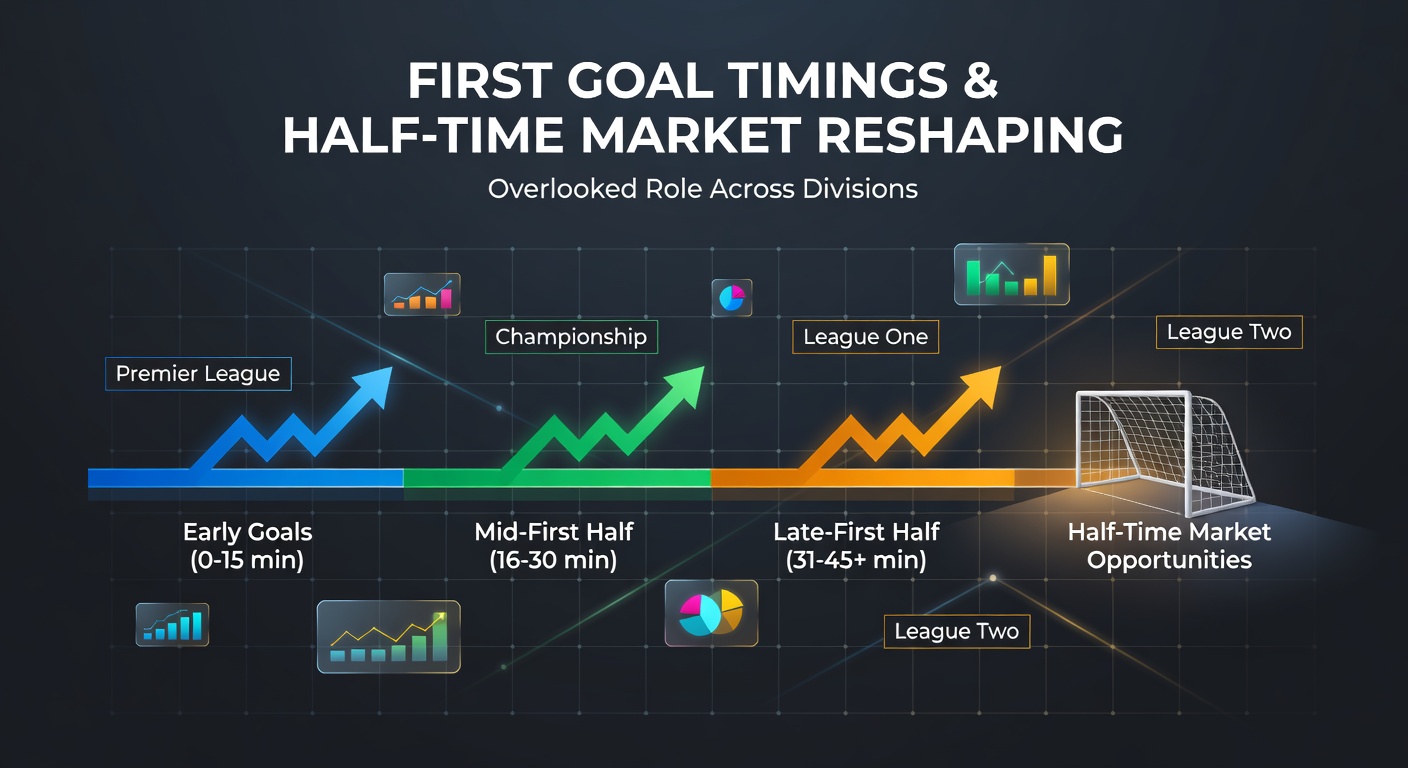
First Goal Timings and Their Influence on Half-Time Market Opportunities in Football Divisions
Analysts tracking match data across English football have documented consistent patterns in when the first goal arrives and how those moments alter half-time betting landscapes in the Premier League, Championship, League One and League Two. Data compiled over multiple seasons shows that goals scored inside the opening 25 minutes frequently trigger adjustments in half-time total goals lines, half-time result odds and both-teams-to-score propositions, creating measurable shifts that punters monitor through live platforms.
Patterns in Initial Goal Moments Across Leagues
Statistics released by league performance units indicate that the average timing for the first goal in Premier League fixtures hovers near the 32nd minute, whereas Championship matches record an earlier average around the 29th minute. League One and League Two fixtures display even tighter clusters, with first goals arriving before the 28th minute in roughly 38 percent of games according to aggregated figures from the 2024-2025 campaign. These timings matter because they compress or expand the window available for half-time market recalibrations once the opening strike lands.
Observers tracking in-play feeds note that an early goal often compresses over 1.5 half-time lines downward while simultaneously inflating underdog half-time draw prices. In contrast, a first goal after the 40th minute tends to preserve pre-match half-time totals and leaves both-teams-to-score markets closer to their opening values. The difference becomes particularly pronounced in midweek fixtures where squad rotation already influences tempo and defensive organisation.
Half-Time Market Adjustments Following Early Strikes
Bookmaker pricing engines respond rapidly once the first goal is registered. Research from European sports analytics groups demonstrates that half-time over 0.5 goals lines shorten by an average of 0.25 in decimal odds when the opener arrives before the 20th minute. Half-time correct score markets also widen, with 1-0 and 2-0 selections attracting increased volume because the probability of a second goal before the interval rises measurably. Those who follow these recalibrations across divisions report stronger liquidity in Championship and League One half-time markets compared with the more conservative movements observed in League Two.
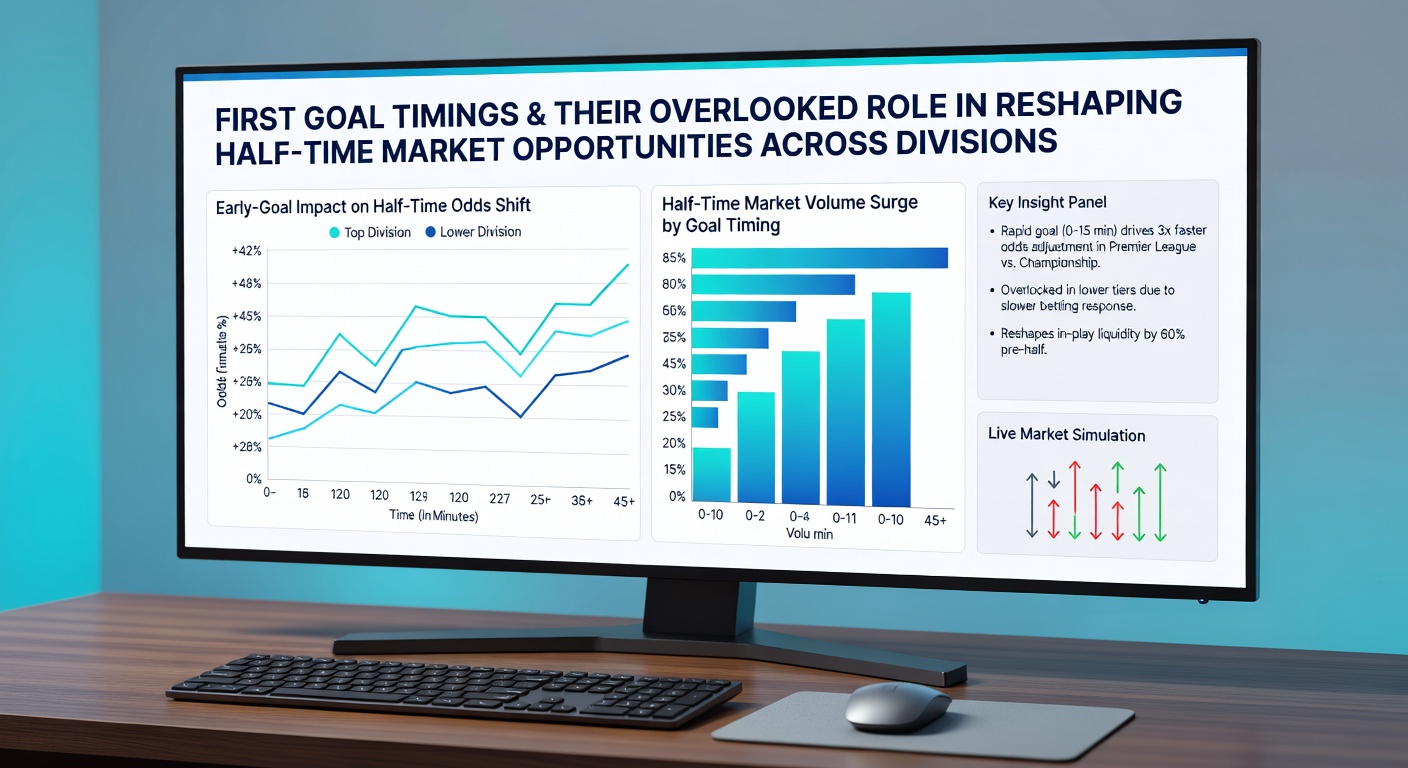
What's interesting is how surface conditions and tactical setups interact with these timings. Data gathered during the 2025-2026 season shows that matches played on heavier pitches record later first goals on average, which in turn reduces the frequency of half-time goal line shifts. Conversely, fixtures featuring high-pressing sides generate earlier strikes and more pronounced half-time market volatility, especially when the pressing team falls behind and pushes numbers forward before the break.
Division-Specific Variations and Data Insights
Championship sides exhibit the highest correlation between first-goal timing and subsequent half-time both-teams-to-score success rates, with figures revealing a 12 percent increase in BTTS half-time outcomes when the opener occurs between minutes 15 and 25. League One matches display a different profile where late first goals correlate with higher half-time under 1.5 probabilities, reflecting more cautious approaches after the breakthrough. League Two data points to steadier half-time result markets regardless of timing, largely because lower average goal tallies limit the scope for dramatic in-play adjustments.
As the 2025-2026 season heads toward its conclusion in May 2026, updated tracking tools now incorporate real-time pitch and weather variables alongside goal timing metrics. These refinements allow market participants to anticipate half-time line movements with greater precision, particularly in divisions where travel schedules intensify fixture congestion. External studies, such as those published by sports research teams at Australian Institute of Sport, have supplied comparative models that highlight similar timing effects in other leagues worldwide.
Practical Applications for Market Observers
Traders monitoring multiple divisions simultaneously use first-goal timing thresholds as triggers for half-time position adjustments. When the opener arrives early, attention often switches to half-time team totals and Asian handicap lines that reflect the new momentum balance. Later first goals prompt reassessment of underdog half-time prices because the trailing side retains more time to equalise before the interval. These patterns repeat across seasons even as squad compositions change, suggesting structural rather than temporary influences.
Additional datasets from FIFA performance analysis reports confirm that first-goal timing distributions remain stable year on year within each division, providing a reliable baseline for modelling half-time market responses. The consistency allows systematic approaches that factor in both the minute of the opening goal and the remaining minutes until half-time.
Conclusion
First goal timings continue to shape half-time market dynamics across all English football divisions by altering probability distributions that bookmakers translate into live odds. The interplay between timing clusters, division-specific scoring rates and external variables such as pitch conditions produces recurring opportunities for those who integrate timing data into their decision frameworks. As tracking technology evolves through 2026, the granularity of these insights is expected to increase, offering further clarity on how early or late strikes recalibrate half-time propositions in real time.