
Dead-Ball Developments Down the Divisions Reshape Accumulator Markets
Lower league football continues to produce measurable shifts in set piece execution that data analysts track across English divisions below the Championship, and those patterns feed directly into multi-bet builder selections each weekend. Teams in League One, League Two and the National League have adopted structured routines that increase the frequency of specific outcomes such as near-post flick-ons, short-corner overloads and rehearsed free-kick deliveries aimed at the six-yard channel. Researchers at the University of Loughborough documented a 12 percent rise in set-piece goals per game in the 2024-25 National League season compared with three years earlier, attributing the change to dedicated dead-ball coaches and video preparation that smaller clubs now employ on tighter budgets.
Clubs allocate more training time to these situations because the cost-benefit ratio remains high, and the same attention appears in match statistics published by Opta each month. One League Two side recorded 38 percent of its total goals from set pieces during the first half of the 2025-26 campaign, a figure that exceeds the division average by eleven percentage points. Multi-bet builders who combine corner counts, player assist props and match total goals therefore find recurring value when they isolate fixtures involving sides with documented set-piece volume.
Training Methods Driving Measurable Change
Coaches now break set-piece work into modular segments that players rehearse at the end of every session, and video packages sent to squad members the night before matches reinforce the same patterns. Data from the English Football League shows that teams using third-party analysis platforms increased their set-piece conversion rate by an average of 4.8 percent between August 2025 and March 2026. The same platforms allow staff to catalogue opponent weaknesses such as zonal marking gaps or goalkeeper positioning tendencies, information that filters into accumulator selections built around corners, cards and goal timing.
National League North and South clubs have followed the same path at a slightly slower pace, yet their adoption rate accelerated after the January 2026 transfer window when several relegated players brought higher-level routines into part-time environments. Those transfers produced a measurable uptick in headed attempts from corners during February and March, figures that betting operators began to price into their builder tools within two weeks of the data release.
Fixture Selection and Market Construction
Accumulators constructed around set-piece edges typically combine three or more legs drawn from the same match or across related fixtures, and analysts note that lower-league schedules in late spring offer repeated opportunities. For example, sides that finished in the top six of League Two during the 2025-26 season posted corner averages above 6.2 per game when playing at home against mid-table opponents, a threshold that appears consistently in historical data sets released by sports data providers. Builders who layer a corner total with a player to be carded and an anytime goal scorer therefore operate with repeated statistical anchors rather than isolated hunches.
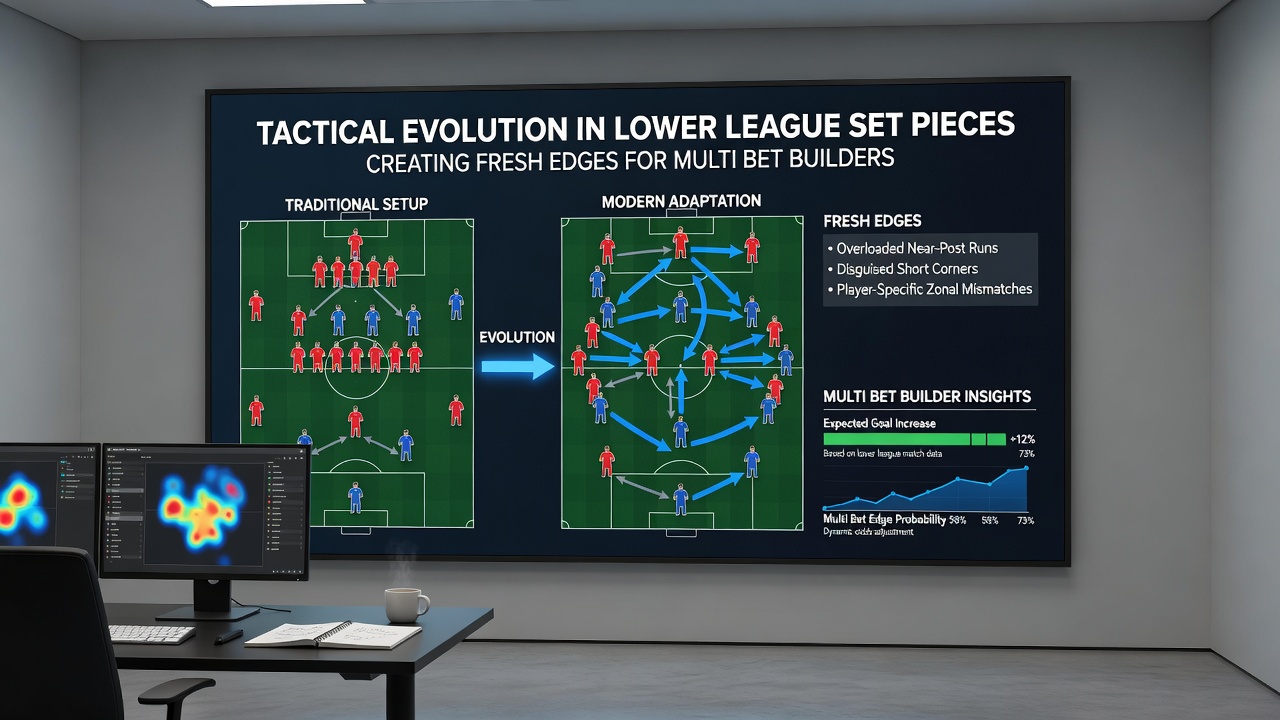
June 2026 marks the close of the domestic season and the start of pre-season friendlies, periods when clubs test new set-piece variations away from competitive pressure. Observers tracking these trials report that several League One sides introduced short-corner variations during June training camps that had not appeared in match footage since the previous autumn, creating fresh data points for the opening weeks of the 2026-27 campaign.
Regional Patterns and Statistical Anchors
Geographic clusters emerge when analysts map set-piece success rates across the country, with northern clubs showing higher rates of direct free-kick attempts while southern sides favour overload routines at the near post. A report issued by the Australian Institute of Sport in May 2026 examined video from twenty English lower-league matches and confirmed that delivery speed and run-up angles differ systematically by region, information that multi-bet platforms now incorporate into their corner and goal markets. Those regional signatures allow builders to weight selections toward fixtures where one side's delivery profile historically clashes with the opponent's marking system.
Betting operators update their builder interfaces weekly, and the refresh cadence aligns with the release of Opta and InStat reports that quantify set-piece volume. Users who refresh their selections midweek therefore capture the most recent trends without relying on outdated season averages. The result is a rolling series of edges that appear most clearly in divisions where budgets limit recruitment yet leave room for tactical specialisation.
Conclusion
Set-piece evolution in lower leagues supplies a steady supply of statistical signals that multi-bet builders incorporate into weekend and midweek accumulators. As clubs continue to refine delivery mechanics, marking assignments and personnel selection, the same data streams remain available to those who monitor league reports and training footage. The pattern shows no sign of slowing ahead of the 2026-27 season, when another round of pre-season testing will generate new inputs for the same market segments.